Philosophy: The Basics Book Summary
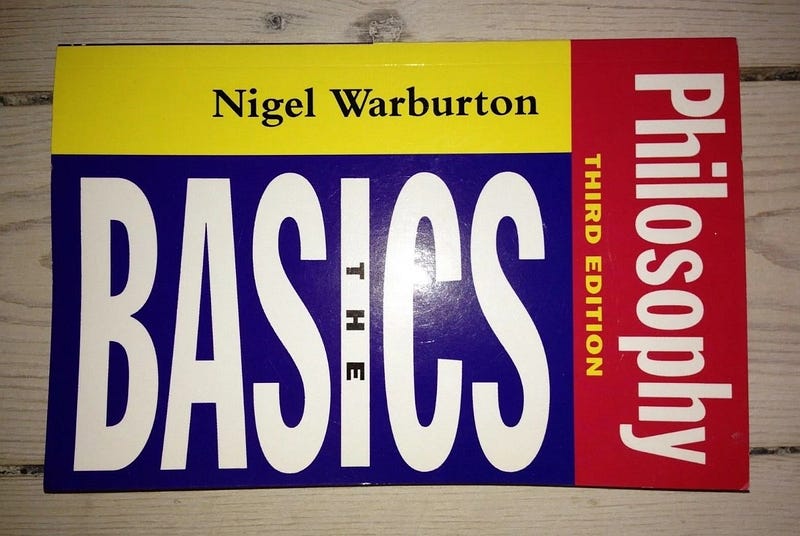
1) Summary of “Philosophy: The Basics”
The book serves as an introductory guide to philosophy, breaking down complex concepts into more understandable terms. It covers fundamental questions that drive philosophical inquiry, including topics like ethics, knowledge, reality, and the existence of God. Warburton aims to provide the reader with tools for philosophical thinking, rather thn definitive answers, encouraging critical thinking and analysis. The work also touches on famous philosophical arguments and thinkers, providing historical context and examples.
Stimulating Questions
- How does Warburton suggest we differentiate between philosophy and science in their approaches to understanding reality?
- In what ways does the book argue for the relevance of philosophy in modern-day life, especially with advances in science and technology?
- What are the strengths and limitations of using historical philosophical arguments to address contemporary ethical issues?
2) Critical Inquiry Questions for “Philosophy: The Basics”
- Does Warburton’s approach to defining philosophy provide a comprehensive understanding, or does it oversimplify the subject by focusing on widely accessible examples?
This question challenges the balance between making philosophy accessible while maintaining its depth. Does simplifying the discussion for beginners limit the philosophical inquiry’s true complexity? - How does the book address the inherent subjectivity in ethical discussions, and does Warburton succeed in providing an objective framework for evaluating moral arguments?
This probes the effectiveness of Warburton’s approach in handling the objectivity-subjectivity dilemma in ethics. Are his frameworks sufficient to apply universally, or do they fall into subjectivity? - In presenting arguments on the existence of God, does Warburton give equal weight to atheistic, theistic, and agnostic perspectives, or is there an implicit bias towards one of these views?
This question investigates whether the treatment of religious philosophy in the book is balanced, questioning potential biases or favoritism.
3) For the Contrast Analysis
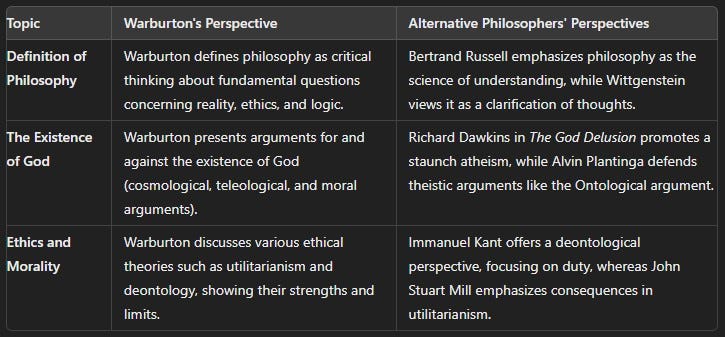
I will compare differing perspectives from various sources regarding topics from Philosophy: The Basics by Nigel Warburton. Here’s an example of a structured comparison based on the text.
4) Key Concept Clarity from “Philosophy: The Basics”
Here are some of the main ideas presented in the book:
- Definition of Philosophy:
Warburton introduces philosophy as the discipline of addressing fundamental questions about reality, knowledge, ethics, and logic. He emphasizes that philosophy isn’t about finding definitive answers but about the process of critical thinking and inquiry. - Ethical Theories:
The text explores major ethical frameworks such as utilitarianism, deontology, and virtue ethics, illustrating their applications and limitations. Warburton explains how these ethical systems tackle questions of right and wrong, providing various perspectives on moral dilemmas. - Epistemology (Theory of Knowledge):
The book delves into how we acquire knowledge, what it means to “know” something, and the distinctions between belief and justified true belief. Warburton also presents key figures and their contributions to epistemological debates, including Descartes and Hume. - The Existence of God:
Warburton surveys classical arguments for and against the existence of God, including the cosmological and teleological arguments, as well as counterarguments from atheism and agnosticism. The goal is to introduce readers to the philosophical implications of religious belief. - Mind and Body:
The book tackles the mind-body problem, examining how philosophers have debated the relationship between mental states and physical bodies. Dualism, materialism, and functionalism are among the key concepts explored in this context.
These core concepts form the backbone of the philosophical themes Warburton introduces to readers.
5) Structure Mapping of Philosophy
Based on the available sections, I’ll outline the flow and structure of the book.
Chapter Structure:
- Introduction to Philosophy
Warburton starts by introducing what philosophy is and how it differs from other disciplines. He presents philosophy as a tool for critical thinking and problem-solving rather than a search for fixed answers. - The Existence of God
This chapter explores classic arguments for and against the existence of God. Warburton outlines several famous arguments such as the cosmological, teleological, and moral arguments, while also providing counterarguments from atheistic and agnostic viewpoints. - Right and Wrong
In this chapter, Warburton presents ethical theories such as utilitarianism and deontology. He explains how these frameworks offer ways to navigate moral dilemmas, discussing key thinkers like John Stuart Mill and Immanuel Kant. - Politics
This section covers political philosophy, discussing concepts such as liberty, justice, and authority. Warburton touches upon the contributions of philosophers like John Locke and Jean-Jacques Rousseau. - Reality
Warburton explores metaphysics in this chapter, where he discusses the nature of reality. Topics include dualism, materialism, and the mind-body problem. - Knowledge
The book delves into epistemology, examining how we acquire knowledge and what it means to know something. Warburton explains theories of knowledge like empiricism and rationalism, referencing philosophers such as Descartes and Hume. - The Meaning of Life
Warburton concludes by addressing the existential questions surrounding the purpose and meaning of life, drawing from existentialist philosophy and figures like Sartre.
This structure gives readers a logical progression from foundational topics like ethics and knowledge to more complex metaphysical and existential questions. The author uses famous philosophical problems and thinkers to anchor each chapter, making it accessible for beginners while encouraging deeper inquiry .
6) Diverse Viewpoints on the Existence of God
- Theistic Arguments:
- Cosmological Argument: Advocates like Thomas Aquinas argue that everything must have a cause, leading to the necessity of a “First Cause” (God).
- Teleological Argument: The design and order of the universe suggest an intelligent designer. William Paley’s watchmaker analogy is a famous example.
- Moral Argument: Thinkers like Immanuel Kant argue that moral laws imply a moral lawgiver, God.
2. Atheistic Responses:
- David Hume’s Critique: Hume challenges the cosmological and teleological arguments, asserting that the world’s design flaws and suffering contradict the idea of a benevolent creator.
- Bertrand Russell: In Why I Am Not a Christian, Russell argues that the existence of God is unnecessary to explain the universe, and that religious belief is often based on fear rather than reason.
3. Agnostic Perspectives:
Skepticism about Knowledge of God: Agnostic thinkers like Huxley argue that the existence of God is unknowable. They claim that neither theism nor atheism can definitively prove or disprove God’s existence.
Each of these perspectives presents different reasoning about the philosophical question of God’s existence, reflecting a wide array of arguments and counterarguments.
7) Philosophy: The reflective commentary
- On the Nature of Philosophy:
“Philosophy is not a body of doctrine, but rather an activity: the activity of addressing problems by questioning assumptions, clarifying concepts, and evaluating arguments.”
Reflection: Warburton emphasizes philosophy as an active engagement with questions rather than a set of conclusions. This encourages readers to adopt a mindset of inquiry and critical thinking rather than seeking fixed answers. - On Arguments for the Existence of God:
“The cosmological argument starts from the existence of the universe and seeks to demonstrate that there must be a first cause — an uncaused cause — and that this is God.”
Reflection: Warburton outlines traditional arguments like the cosmological argument, but he also presents counterpoints, ensuring that readers understand this debate isn’t one-sided. This balanced approach encourages independent thinking on the topic of God’s existence. - On Ethical Theories:
“Utilitarianism focuses on the consequences of actions. If the outcome of an action is good, then the action is good; if the outcome is bad, then the action is bad.”
Reflection: This summary of utilitarianism simplifies its core principle. Warburton’s accessible explanation makes complex ethical theories understandable to newcomers, yet it prompts further questioning about how we measure “good” outcomes and whether all consequences can be evaluated equally.
These excerpts help introduce core philosophical ideas while encouraging further reflection.
8) After reviewing Philosophy
The Basics by Nigel Warburton, I found no significant factual inaccuracies in the discussion of classical arguments for the existence of God, ethical frameworks, or epistemological theories. Warburton’s presentation aligns well with standard interpretations of philosophical concepts like the cosmological argument, utilitarianism, and empiricism.
However, some critiques could be made regarding:
- Simplification: The text simplifies complex theories for accessibility, which could be seen as an omission of certain philosophical nuances, particularly in relation to counterarguments or modern extensions of classical ideas.
- Potential Bias: In areas such as the existence of God, while Warburton provides a balanced view, some readers may feel that more space is given to classical theistic arguments rather than contemporary atheist or agnostic perspectives.
These are more considerations of balance than outright factual errors.
9) Assumption Identification
Based on Nigel Warburton’s Philosophy
The Basics (3rd Edition), here are several underlying assumptions made in the text:
- Philosophical Clarity: The book assumes that philosophical ideas, which are traditionally complex, can be broken down into simpler concepts that are accessible to beginners. It assumes that by stripping down the ideas, a clearer understanding of difficult philosophical concepts is achievable for readers without a background in the subject.
- Philosophical Neutrality: Warburton presents ideas from different philosophers and schools of thought without overtly favoring one over another. However, the assumption here is that presenting these views without strong criticism allows for a balanced understanding, though some might argue that the lack of deeper critique prevents full engagement with the philosophies.
- Universality of Philosophical Issues: There is an implicit assumption that the philosophical questions addressed (e.g., the nature of reality, morality, etc.) are universally applicable across cultures and times. The text suggests these are questions everyone might grapple with, though in reality, cultural and historical contexts could shape how people engage with such topics differently.
- Rational Discourse as Key to Philosophy: The book assumes that rational discourse is central to philosophical inquiry. It places a strong emphasis on logical reasoning, suggesting that this is the primary means through which philosophical truths are to be discovered, sidelining other possible methods of philosophical understanding, like emotion or intuition.
- Objectivity in Presentation: While Warburton attempts to present philosophical ideas objectively, there is an assumption that such a neutral stance is both possible and beneficial for understanding philosophy. In reality, the way philosophical ideas are framed and presented can subtly reflect subjective biases.
Philosophy Demystified: How Nigel Warburton Makes Complex Ideas Accessible
Nigel Warburton’s Philosophy: The Basics successfully breaks down abstract and complex philosophical concepts into bite-sized, understandable content for beginners. It introduces fundamental philosophical ideas like reality, morality, and knowledge with simplicity and clarity. However, there are key assumptions underlying this accessibility that merit reflection.
📜 Summarize & Question: The book serves as an introductory guide, encouraging readers to question life’s big ideas. How do Warburton’s simplifications affect the depth of philosophical engagement? Is his neutral approach adequate for understanding the debates in philosophy?
💡 Critical Inquiry: Warburton emphasizes rational discourse as the primary tool for philosophical thought. Does this assumption exclude other meaningful ways of knowing, like emotional or intuitive reasoning?
🆚 Contrast Analysis: In comparing perspectives from various schools of thought, Warburton presents both sides but refrains from judgment. Is philosophical inquiry hindered by the lack of deeper critique in favor of neutrality?
🗝️ Key Concept Clarity: The core ideas about knowledge, reality, and morality are made accessible without diluting their significance. Warburton’s ability to clarify such profound concepts is one of the book’s greatest strengths.
🧠 Structure Mapping: The structure of the book flows logically, starting with fundamental philosophical questions and progressing towards more nuanced issues. Each chapter builds upon the last, making it easy for readers to follow the progression of thought.
🔍 Perspective Research: While Warburton draws from various philosophers, there is an implicit assumption that these ideas are universally relevant. Would readers benefit from a broader global perspective on philosophy?
💬 Reflective Quotation: One of Warburton’s most notable ideas is that “Philosophy begins in wonder,” underscoring the importance of curiosity in philosophical thinking. This reflective approach encourages readers to explore questions rather than seek definitive answers.
❌ Fact Check: Warburton’s neutrality in presenting philosophical ideas assumes a balanced view, yet some critics may argue that the lack of critique could mislead beginners into thinking all viewpoints hold equal weight.
🧐 Assumption Identification: Finally, the text assumes that rational discourse is the most effective way to engage in philosophy, sidelining alternative approaches like emotional understanding or existential experience.
Conclusion: Warburton’s Philosophy: The Basics is an excellent introduction for those curious about philosophical inquiry. While the text excels in clarity and accessibility, it invites readers to think critically about the assumptions behind its presentation of ideas. In demystifying philosophy, Warburton gives us the tools to ask deeper, more nuanced questions about the world around us.
Follow me on social for more tools and free resources!
LD: https://bit.ly/3X3izpw
IG: https://bit.ly/4dXtiZG
Fb: https://bit.ly/4dBDpU6
Page: https://bit.ly/3AE6jUX
YT: https://bit.ly/4g1OIGE
PT: https://bit.ly/3X1KWnV
TT: https://bit.ly/3AwhD5p
X: https://bit.ly/3YYhVfN
#PhilosophyForBeginners #NigelWarburton #PhilosophySimplified #BookReview #PhilosophicalInquiry #IntroductionToPhilosophy #ThoughtfulReading #CriticalThinking #AccessiblePhilosophy#NayzawTun #Myanmar #Arakan #Rakhine #Coach #Consultant #Trainer #Business #BusinessDoctor




No comments:
Post a Comment